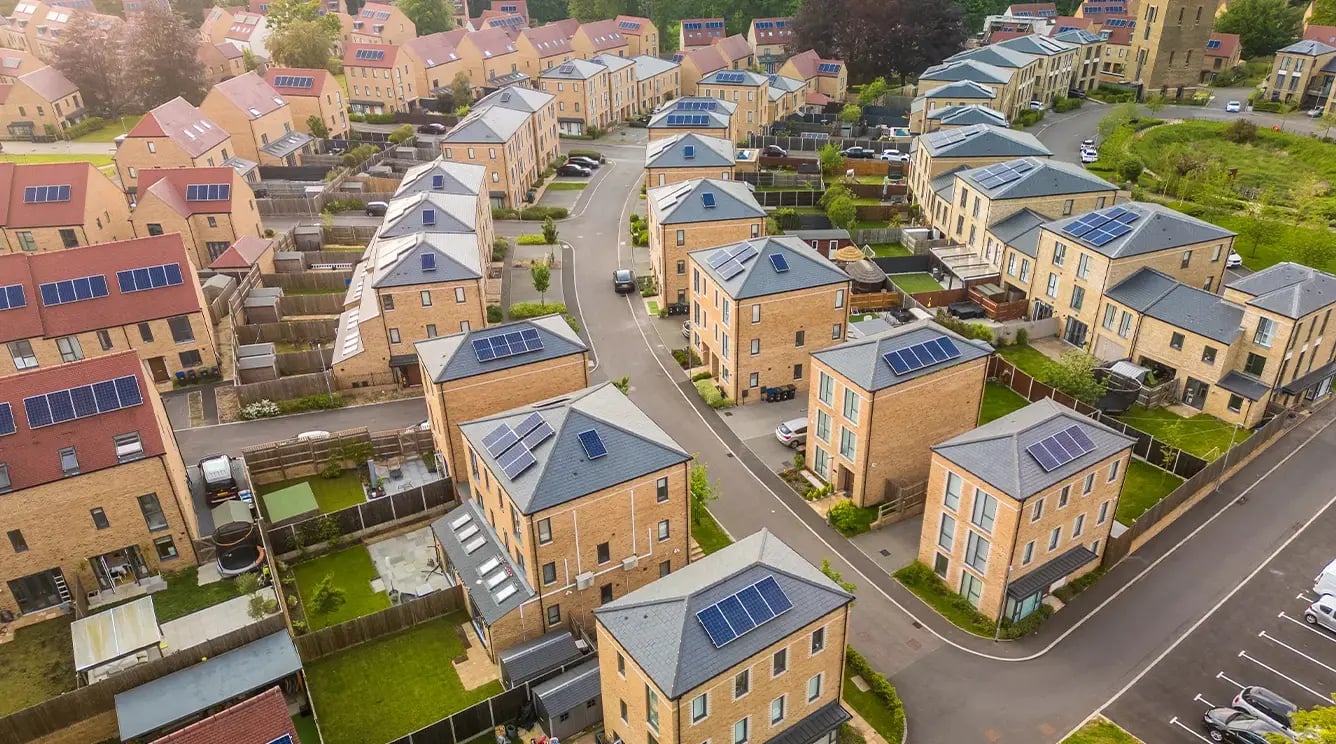
As the government announced plans to create “zero bill” homes through solar power investment, it was reported that renewable energy produced a record amount of electricity in Great Britain.
Figures from the National Energy System Operator (NESO) showed that wind was the biggest single renewable source of electricity with solar powered electricity rising by almost a third.
However, there was a slight rise in electricity from fossil gas.
Under its “clean power” target, the government aims to use hardly any polluting gas to produce electricity by 2030, and believes clean power can greatly reduce energy bills.
Wind generated almost 30 per cent of Great Britain’s electricity last year, and solar power more than six per cent, but gas still produced roughly 27 per cent.
All in, according to the NESO data, that means Britain’s electricity was slightly more polluting than in 2024.
The government has defined its “clean power” target as 95 per cent of all electricity generated in Britain coming from renewables and nuclear power by 2030. It is currently believed to be around 75 per cent.
Experts say solutions to the challenge include batteries to store renewable electricity for use when it is less sunny and windy – such as the two installed at AESSEAL’s Rotherham headquarters. Another challenge is the need to upgrade the grid.
Energy secretary Ed Miliband has set out plans for new “zero bill” homes, including proposals to allocate up to £15bn to its warm homes fund over four years.
The money will be spent on solar energy, batteries and heat pumps, with the hope that some households – the poorest – will pay little or nothing in energy bills, reducing fuel poverty and accelerating the roll-out of low-carbon home technologies.
Restrictions on plug-in solar panels, which can be installed on balconies, patios or flat roofs and plugged into power points by residents, will also be reduced.
The government is also planning to work with banks and energy companies to provide capital for schemes which would allow homes to install the equipment with no upfront costs, then repaid in bills over five or ten years.
Mr Miliband said: “After years of delay and under-investment, this government is keeping its promise to take back control of Britain’s energy with clean home-grown power.”
Nigel Banks, technical director at Octopus Energy, said as many as one million homes with good insulation could slash their bills to almost nothing if they installed solar panels, batteries and a heat pump.
“With flexible energy tariffs, the opportunity is now there for homeowners to effectively pay no energy bills at all,” he said.
The UK has one of the oldest and leakiest housing stocks in western Europe and almost 29 million homes will need to be retrofitted before 2050, according to the UK Green Building Council.
UKGBC chief executive Simon McWhirter said: “UKGBC has long issued a clarion call for a long-term national strategy to tackle the challenge of retrofitting all our homes and commercial buildings at scale, and we are pleased to have worked alongside industry and government to help shape its development.
By harnessing abundant solar energy and heat pump technology to both heat and cool buildings, the plan will help future-proof against rising bills and our rapidly warming climate.”