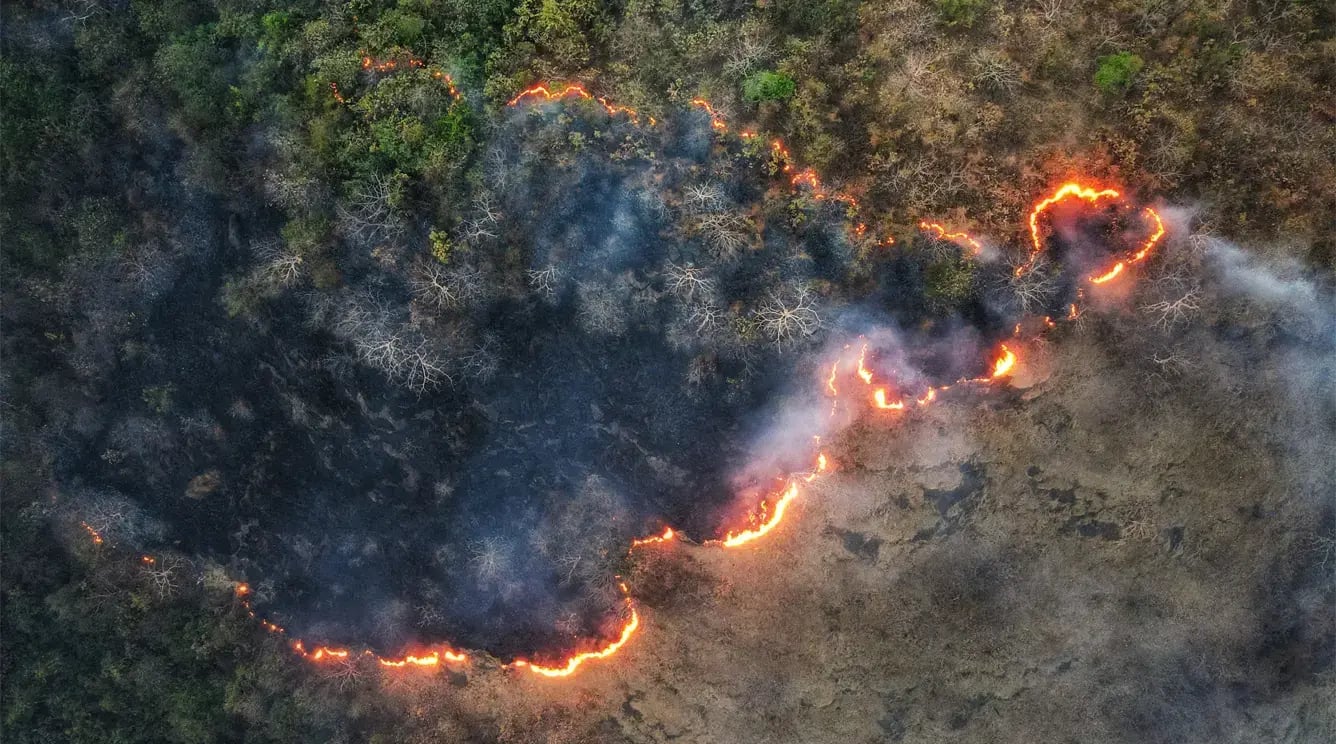
Wildfires have scorched millions of acres of land across Europe, hitting huge areas of France, Spain and Greece.
Only weeks after record-breaking heatwaves, parts of the UK are burning too, with fires in Suffolk, the Peak District, Wales and Scotland.
Water minister Emma Hardy said the UK needs to be “prepared for this new normal”, as climate changes and droughts become “increasingly common”.
According to the European Forest Institute, a wildfire “is a chemical reaction of combustion, which requires a source of heat (lightning, an agricultural “burn” which escapes), oxygen and fuel (forests, shrubs or pastures) to get started.”
But how do we stop it from happening?
For a start, businesses can help by funding prevention technology, enforcing strict supply chain rules, and investing in landscape restoration.
Managing wildfires is essential, but rebuilding forests by planting trees in the aftermath is just as vital to maintain natural biodiversity, wildlife habitats, water quality, soil stability and community health.
Supporting verified reforestation and ecosystem restoration campaigns - as the AES group has in Scotland and Northern Ireland - is vital.
Restoring wetlands, something else AESSEAL has done at its Mill Close headquarters in Rotherham, offers protection to healthy soils and wet peatlands, which retain moisture and naturally slow fire spread.
Flammable monoculture tree plantations can be replaced with resilient, native mixed woodlands, while mechanical thinning and controlled grazing programs will remove excess dry brush.
Other advice includes checking on the policies and behaviours of suppliers - prevent them from using slash-and-burn methods or clearing carbon-rich peatlands for agriculture.
You can limit industrial ignition risks during dry spells, and clear dry leaves, debris, and scrubland around property and high-risk zones to reduce flammable fuel.
The situation could yet become worse. Scientists are warning that pyrocumulonimbus clouds – unprecedented in southwest Europe – are forming. These are thunder clouds created by intense heat from the Earth’s surface.
This heat that results in the vigorous updraft comes from fire or volcanic eruptions. Bursts of rain can then carry embers from the fire, igniting spot fires away from the source. In some cases, dry lightning from these storms can strike, further spreading the wildfire.
Strategic Climate Risks executive director Laurie Laybourn said: “Any disaster is very complex. The causes are multilayered, including how we build and how we use land… but climate change is supercharging the conditions that make us vulnerable to things like wildfires and that has been something that’s been predicted now for many decades and tragically becoming true in front of our eyes. This should be a moment of profound alarm and reflection, particularly for governments.”
According to Copernicus, the European Union’s climate change service, Europe is now the fastest warming continent on Earth, with temperatures increasing twice as fast as the global average since 1980.
As always, we need to act quickly.